Listening to migrant voices in Spain
At ReRootED, we believe that understanding people’s lived experiences is essential to building meaningful and inclusive solutions. Behind every migration journey there is a person with aspirations, skills and dreams, but also obstacles that can make integration difficult.
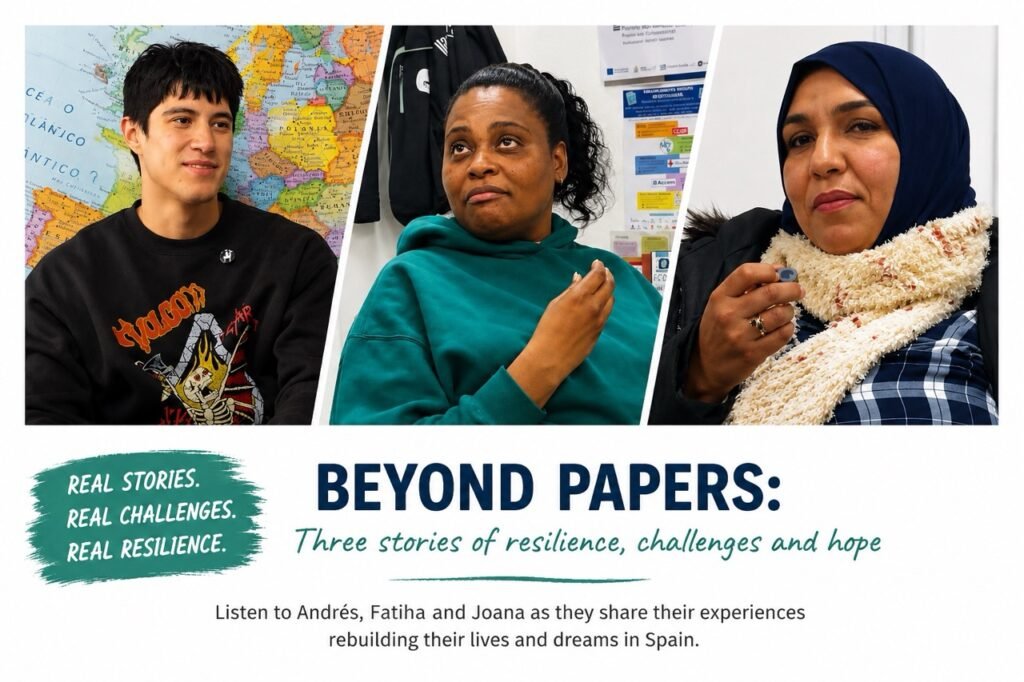
Through a series of interviews conducted by participants of Llanero Solidario’s Conecta Project, we listened to three migrant voices currently rebuilding their lives in Spain: Andrés, Fatiha and Joana. Their stories are different, yet they reveal common challenges that many migrants continue to face across Europe.
Andrés: “I want to study, work and build my future”
For Andrés, one of the biggest challenges is the lack of legal documentation. Everyday activities that many people take for granted become complicated when administrative barriers limit access to opportunities.
Without legal status, finding formal employment becomes extremely difficult. As a result, many migrants are pushed into informal work, where wages, schedules and working conditions often depend entirely on employers.
Despite these difficulties, Andrés remains focused on his goals: studying, obtaining a driving licence and accessing decent employment.
Fatiha: balancing work, family and responsibility
Fatiha arrived in Spain from Morocco and is raising five children. Her daily life is a constant exercise in resilience.
She works caring for children whenever opportunities arise, but like many migrants, she struggles to find formal employment without the necessary documentation. At the same time, she continues learning the language and supporting her children’s education.
Although work remains her greatest challenge, Fatiha also highlights something important: feeling respected and welcomed by the people around her.
Joana: starting over far from home
Joana came from Colombia seeking better opportunities for herself and her family. Back home she worked as a teacher. In Spain, however, she currently earns a living cleaning houses while her husband takes temporary jobs in agriculture and construction.
Housing has become one of her greatest difficulties. Without stable employment and formal contracts, accessing rental accommodation is often impossible. As a result, the family currently lives in extremely precarious conditions.
Beyond employment and housing, Joana speaks about another challenge shared by many migrants: being separated from loved ones and unable to travel home to visit family members.
Challenges that go beyond legal status
Spain has recently introduced measures aimed at facilitating the regularisation of many migrants. For people like Andrés, Fatiha and Joana, these changes may help remove some important administrative barriers.
However, their testimonies remind us that integration does not end with obtaining legal status.
Access to decent work, affordable housing, education, social participation, emotional wellbeing and community support remain essential for building a stable and meaningful future.
Why these stories matter for ReRootED
At ReRootED, we work to strengthen resilience, emotional wellbeing and social entrepreneurship among migrant communities. Listening to real experiences helps us better understand the barriers people face and develop more relevant educational resources and support tools.
The stories of Andrés, Fatiha and Joana remind us that behind every statistic there is a human story. By listening to these voices, we can build more inclusive communities and create opportunities that help people not only survive, but thrive.