
Most entrepreneurship programmes start with content: business plans, finance, and marketing. They assume participants arrive ready to absorb, apply, and perform.
In reality, many migrant and displaced women start from a very different place — managing stress, uncertainty, disrupted networks, and the pressure to rebuild stability while learning.
When training ignores this, it does not fail immediately. It fails later — when participants disengage, avoid risk, or experience failure as confirmation that they are “not capable”.
This is the gap we are working with.
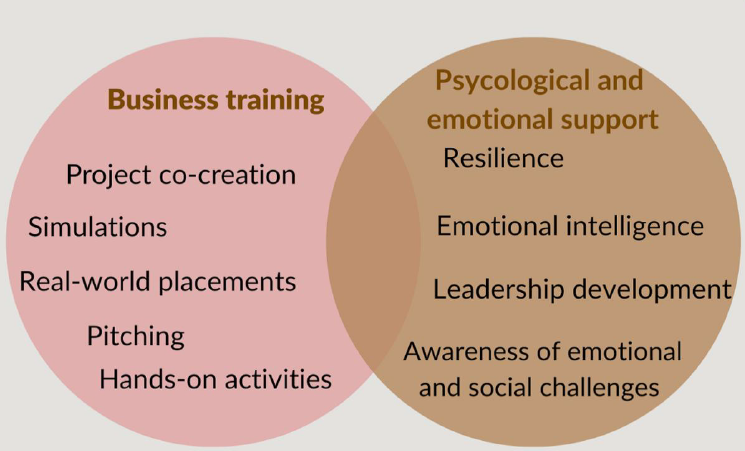
One of the key outcomes of the ReRootED project is a training programme designed to support migrant and displaced women in building social entrepreneurship pathways — without separating business development from mental and emotional wellbeing.
Based on the ReRootED framework, the training is being structured around three interconnected dimensions: business competencies that are immediately applicable, emotional and mental wellbeing as a condition for learning, and trauma-informed environments that make participation possible in the first place.
These elements are not separate modules. They shape how every session is structured — how it starts, how reflection is integrated, and how peer dynamics are built.
For example, instead of treating failure as a case study, we approach it as a lived experience that needs to be processed, not ignored.
Instead of assuming motivation, we design for fluctuation in energy, attention, and confidence.
What is emerging is not a standard curriculum. It is a training experience aligned with how learning actually happens under pressure.
Entrepreneurship, for many women in this context, is not a linear path. Training should not pretend to be.